Read our complete National Register District Narrative and see our Survey Maps and Photos here.
Today’s Travis Heights is actually now a collection of many smaller neighborhoods platted at various times throughout the history of Austin, within the boundaries of the original Travis Heights Subdivision. Much of this development history is closely related to the history of Austin’s transportation networks, primarily Congress Avenue and the ferry which brought suburban settlement south of the river.
After the construction of the 1876 Congress Avenue bridge, the Swisher Addition was platted on both sides of South Congress Avenue as the first urban planning act in South Austin and people felt more comfortable moving south of the river, without fear of the earlier bridges (which failed often) leaving them stranded away from town’s amenities.
Soon after, in the 1880s, Fairview Park was developed by young real estate speculators from New York. Inspired by trends in urban planning coming from the northeast in the wake of Frederick Law Olmsted’s and Calvert Vaux’s popular Greensward Plan for Central Park, they laid out a picturesque suburb with winding trails and large lots. We have to wonder if today’s Academy Drive, originally named The Ramble, was perhaps a tribute to the main road through Central Park, whose main road was also The Ramble?
Unfortunately, a great financial depression struck at the turn of the century and further development stalled until the 1910s.
The Travis Heights subdivision came later in the 1910’s, after the city extended the streetcar system south of the river, the Travis Heights subdivision developed to the south and east of Fairview Park. Many of these homes filled in the original large lots. The success of this development overwhelmed the earlier attempts, subsuming them into what we now refer to as Travis Heights.
Sources
South Congress Avenue Preservation Plan
McGraw Marburger & Associates, May 2003 (pdf)
Greater South River City Neighborhood Plan
September 2005 (pdf)
Bouldin Creek Neighborhood Plan
May 2002 (pdf)
History and Character-defining Features of Little Stacy Park
Kim McKnight, Austin Parks and Recreation, August 2011 (pdf)
Our Little Town: Travis Heights Arrives
Mike Clark-Madison, Dec. 4, 1998
Fairview Park and Travis Heights’ History
From 1988/89 brochures for the Live Oak Festival Tour of Homes, Richard & Barbara Cille (pdf)
Austin’s Streetcar Era
A. T. Jackson, in The Southwestern Historical Quarterly, Oct 1954 (pdf)
Collection of South Congress Ave images and maps illustrating its changes from 1920s-1960s
Josh Conrad, 2011(pdf, 95 MB)
South River City Citizens Records, An Inventory of the Collection, 1969-2011
Austin History Center
Historic Residential Suburbs: Guidelines for Evaluation and Documentation for the National Register of Historic Places
U.S. Department of the Interior, National Park Service
Grace United Methodist Church, Austin, TX: Our History
Fire Station No. 6: Austin Fire Museum
Congress Avenue Baptist Church
South Austin Christian Church
Christ Lutheran Church: History
Maps
Austin and Surrounding Properties
Bergen, Daniel & Gracy, March 1891 (jpg)
City of Austin Map
Austin Chamber of Commerce, March 1939 (jpg)
1922 Sanborn Maps
- Index Sheet (jpg)
- Sheet 58, East of South Congress, Nellie to Gibson (jpg)
- Sheet 60, East of South Congress, Gibson to Milton (jpg)
- Sheet 63, East of South Congress, Milton to Johanna (jpg)
- Sheet 64, East of South Congress, Johanna to Live Oak (jpg)
- Sheet 96, Travis Heights, Edgecliff to Monroe (jpg)
1935 Sanborn Maps
- Index Sheet (pdf)
- Sheet 222, East of South Congress, Fairview Park to Elizabeth St (pdf)
- Sheet 224, East of South Congress, Elizabeth to Leland (pdf)
- Sheet 225, Newning east to Travis Heights Blvd, Edgecliff south to Monroe (pdf)
- Sheet 226, East of Travis Heights Blvd, Edgecliff south to Monroe (pdf)
- Sheet 227, South Congress at Live Oak (pdf)
1960 Sanborn Maps
- Sheet 222, East of South Congress, Fairview Park to Elizabeth St (pdf)
- Sheet 224, East of South Congress, Elizabeth to Leland (pdf)
- Sheet 225, Newning east to Travis Heights Blvd, Edgecliff south to Monroe (pdf)
- Sheet 226, East of Travis Heights Blvd, Edgecliff south to Monroe (pdf)
- Sheet 227, South Congress at Live Loak (pdf)
- Sheet 229, East Side Dr east to Kenwood, Monroe south to Live Oak (pdf)
Aerial Photos
Aerial Photo, Sep 10, 1940
#COR-8-19, Austin History Center, Austin Public Library (jpg, 41 MB)
Austin Aerials- Terrace Motel. Looking East, May 17, 1955
Douglass, Neal. The Portal to Texas History. (jpg)
Austin Aerials- Terrace Motel. Looking North, May 17, 1955
Douglass, Neal. The Portal to Texas History. (jpg)
Aerial of South Austin and downtown looking North from directly above South Congress, October 14, 1949
Douglass, Neal. The Portal to Texas History. (jpg)
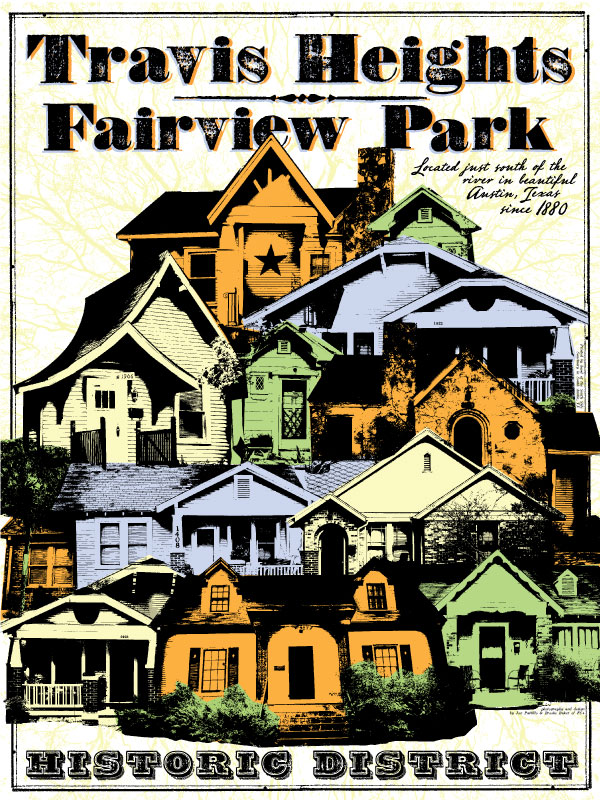
 Travis Heights-Fairview Park Historic District